

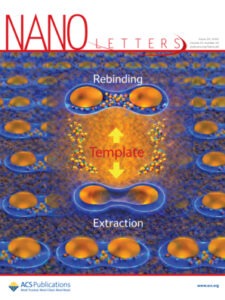
The NEC team is happy to announce that a recent article has been selected for the cover of Nano Letters, highlighting their work on conductive π-conjugated molecularly imprinted polymers combined with plasmonic nanostructures for highly sensitive molecular sensing.
Pierre Bleteau, Sarra Gam-Derouich,* Thi Duyen Dinh, Cat Luong Nguyen, Van-Quynh Nguyen, Stephanie Lau-Truong, and Jean-Christophe Lacroix*
Molecularly imprinted polymers (MIPs) have emerged as powerful synthetic receptors capable of recognizing specific (bio)molecules through tailor-made binding sites. Traditionally based on poly(methyl acrylates) and hydrogen bonding, their extension to π-conjugated systems offers new opportunities for functional integration. In this work, we explore this avenue by combining a plasmonic platform composed of gold nanoparticle dimers fabricated by electron-beam lithography with a PEDOTbased imprinted polymer. The polymer growth is preferentially confined within the nanogaps of the dimers, forming molecularly imprinted cavities for methylene blue (MB). The detection of MB is achieved via both the localized surface plasmon resonance (LSPR) shift and surface-enhanced Raman Scattering (SERS), demonstrating sensitivity down to nanomolar concentrations. This approach illustrates the potential of π-conjugated MIPs for highly sensitive molecular sensing platform.
DOI: Hybrid Plasmonic Nanostructures Using π‑Conjugated Systems for Molecularly Imprinted Polymers